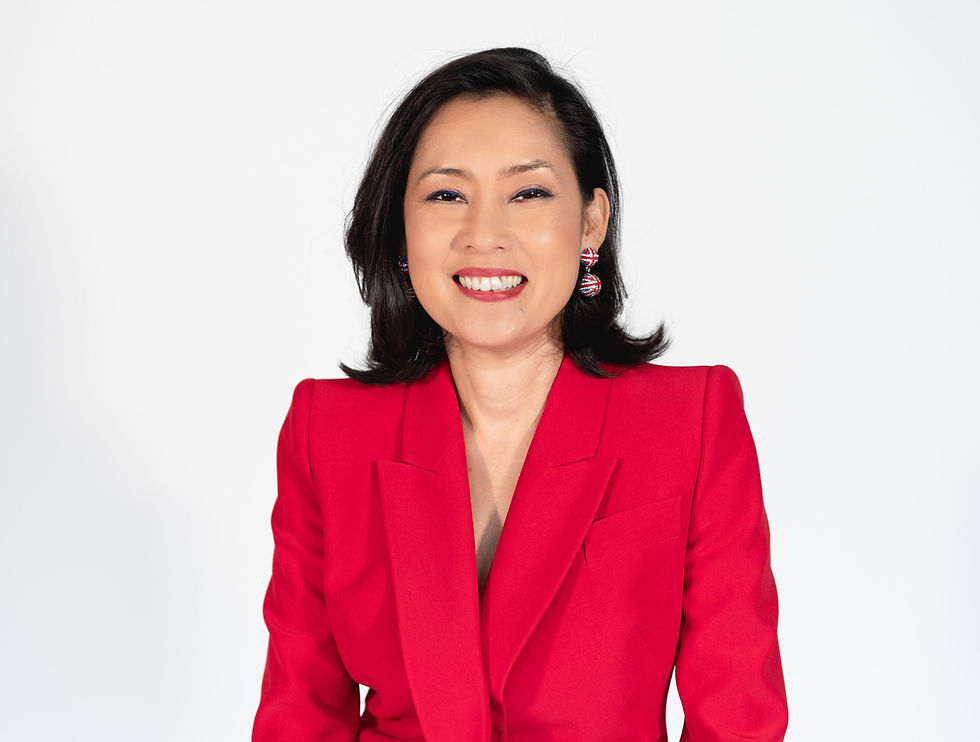
Stepping Into the C-Suite: Executive Coach Julia Darlington on Power, Imposter Syndrome, and Resilience
An interview with Julia Darlington

Stepping into a senior executive role requires more than operational expertise; it demands a fundamental shift in leadership identity, workplace relationships, and emotional resilience. Executive Coach Julia Darlington shares her tips for rising to the C-suite.
Drawing on three decades of high-stakes retail leadership - rising from Trainee Selector at M&S to Chief Brand & Product Officer at Radley - Executive Coach Julia Darlington's CV is impressive and her leadership skills unrivalled. In this exclusive interview with The Industry Leaders, Julia shares practical frameworks for dismantling invisible barriers like imposter syndrome and people-pleasing, navigating difficult conversations through Non-Violent Communication, and how women can influence male-dominated C-suites with empathy. Julia believes rising leaders can build strategic board-level alliances and sustain peak performance without succumbing to burnout, they just need the right coaching.
How did three decades in the global fashion industry at Director level shape your approach to Executive Coaching?
In 2000, at the age of 36, I was promoted to Director for the first time and experienced the transformative power of coaching. Prior to this, I had never been coached and had no real idea of what it was or what its purpose could be. That first experience was literally life-changing, planting the seed that eventually grew into my new career and my own coaching business. I found it so powerful to finally have someone in my camp - a guide, confidant, and trusted ally on the journey with me. It opened up a world I had always been fascinated by without realising I could build a career in it. I had always been extremely ambitious, full of ideas and determination, yet equally riddled with self-doubt and uncertainty, with no one to share that with, ask advice from, or explore my potential alongside. Over the following ten years, as I gained more senior leadership experience across various iconic British High Street brands, I was fortunate to work with different coaches across vastly different businesses, from privately owned firms and PLCs to start-ups and established global enterprises.
My personal journey from Trainee Selector at M&S to Chief Brand & Product Officer at Radley has been a massive influencing factor in my approach to executive coaching. I bring first-hand experience of what a woman rising up the corporate ladder must navigate, and I understand the challenges an executive faces because I have had to confront and solve them myself. Throughout my career, I managed and delivered multi-million-pound budgets in an extremely fast-paced, rapidly changing industry while driving sales and profitability and minimising markdowns across B2B wholesale, B2C retail, and e-commerce models, each presenting its own unique pressures. I also had to understand the environmental impact of business decisions and adhere to ESG guidelines, all while accounting for global market complexities - such as cultural nuances, economic backdrops, climatic influences, and political landscapes - when building product collections.

At the same time, I navigated global manufacturing and supply chains to source and produce to the required quality, price, and delivery schedules needed to hit profit targets, managing complex critical paths and logistics across international markets. I lived through the emergence of the internet and the 24/7 competition it brought, adapting alongside the rise of e-commerce to create a seamless omnichannel experience alongside traditional bricks-and-mortar retail. Beyond the operational demands, I had to manage both internal and external politics in a high-pressure environment while developing and coaching multi-disciplinary teams to collaborate effectively in a fiercely competitive sector. Because change and reinvention are continual in fashion, the ability to adapt and pivot rapidly under pressure is essential for success. This lived experience shapes everything I do today, allowing me to seamlessly combine coaching, mentoring, and consulting, and knowing precisely when to draw on each so my clients can navigate their unique challenges and thrive.
How should leaders re-engineer workplace relationships as they move from peer roles to senior exec roles?
When stepping up into an executive role, it is vital to recognise that an invisible line now exists between yourself, your peers, and your team. In an executive position, you are privy to confidential, high-level information, so you must be discerning about what can and cannot be shared. In my view, you simply cannot remain ‘friends’ in the exact same way, either inside or outside of work, though whether that shift feels subtle or blatant depends very much on the individual.
Becoming aware of and staying true to your intrinsic values ensures you continue to lead from an authentic place. Eliciting a client’s values early in our coaching relationship is a powerful way to help them re-establish their new leadership identity. An executive must make choices that serve the best outcomes of the business rather than individual colleagues or teams, so being able to ‘put your tin hat on’ when making tough calls is essential. At the same time, you must become visible and build relationships upwards with the executive team, the board, and key internal and external stakeholders. Understanding each person’s role and how it shapes major business decisions, while building new alliances rooted in trust and adding as much value as possible across the leadership team, will firmly establish a new executive as a vital part of the business’s future.
What is your framework for navigating difficult, high-stakes conversations without breaking trust?
My approach begins with thorough assessment and research before the conversation even takes place. I endeavour to understand the situation in as much detail as possible, including everything that happened in the lead-up to it, while collating all relevant historical data and information. From there, I get completely clear on who is involved, who needs to be included, who the key stakeholders are, and what the exact purpose and desired outcome of the meeting should be.
Once in the room, a framework I frequently rely on is Non-Violent Communication, which can be remarkably effective. Its premise is that by focusing on concrete facts and the shared needs of those involved, everyone feels heard and no one feels attacked or defensive, which naturally preserves high levels of trust. It works through four straightforward stages: starting with observation, where you state what happened neutrally without judgement; moving to feeling, where you name your emotion simply without assigning blame; connecting that feeling to a core value or requirement through need; and concluding with a request for a specific, doable action.
What invisible barriers hold executive women back and how do you start dismantling them?
Women face a wide range of barriers. Some are internal and often unconscious ones that we have created and harboured for years, and others that are external and embedded in the world around us. Internal barriers live in our minds and carry immense weight, so the first step in dismantling them is helping my clients build conscious awareness of their existence through metacognition, before coaching them to remove, replace, or reframe those patterns so they can move forward.
The most frequent internal blocks I see are self-limiting beliefs, which are essentially stories we have constructed to keep ourselves safe, feel a sense of belonging, and make sense of the world. When those stories no longer serve a client and hold them back from their potential, we work together to install new, more resourceful beliefs. We also look closely at defining moments from childhood conditioning and programming, identifying early experiences that shaped their views on what they can and cannot have, which opens up fresh ways of thinking. Alongside this is the work of overcoming unspoken fears - such as the fear of failing, not being good enough, experiencing imposter syndrome, being found out, or facing conflict - by naming them openly and providing practical tools to manage them when they surface. People-pleasing is another prevalent hurdle, rooted in historical conditioning that teaches women not to be too loud or outspoken, to keep the peace, and to measure their worth by keeping everyone else happy. This often leads women to say yes to menial tasks, inadvertently projecting a lack of the fire and authority needed for top roles; unpacking that behaviour frees them to make tough calls even when it rocks the boat. Underpinning all of this is low self-confidence and self-belief, which holds women back at every stage, not just at executive level, and is something I address fundamentally across all my coaching programmes and workshops.
External barriers can be trickier to navigate because many have existed for centuries and remain woven into society. Societal conditioning and gender bias are very real and continue to hold women back from reaching the top jobs; while things have improved, progress has not gone far or fast enough. Because we cannot single-handedly rewrite society overnight, the crucial shift is focusing our energy on what we can actually control. I use Stephen Covey’s Circles of Concern and Influence to help clients redirect their focus, build inner confidence, and take resourceful action toward the outcomes they want.
How do you coach female leaders to integrate empathy, intuition and holistic well-being into male-dominated corporate environments?
First, it helps to remember that plenty of men also possess deep intuition and empathy, so identifying who your male allies are can make a real difference when integrating these softer skills into a male-dominated environment. To help my clients navigate these dynamics, I draw on my work as a consultant and practitioner of Extended DISC, a powerful energetic behavioural profiling tool. It reveals how different energy types navigate the world, highlighting their key drivers and motivators, what they fear, how they communicate and absorb information, how they respond to change, and how they make decisions. Armed with that insight, a leader can anticipate how others will behave in any given situation and tailor their communication to create a win-win outcome, allowing my clients to influence colleagues, including senior men, and bring empathy, intuition, and well-being naturally into the workplace.
How can rising leaders influence board-level decision makers while making strong peer alliances across teams?
It starts with understanding where the power sits and who holds influence over which decisions, and then deliberately becoming visible to those key stakeholders. If you remain invisible, you simply cannot make an impact, so actively creating opportunities to get in front of decision-makers, be seen and heard, and build genuine relationships is essential. Meanwhile, strong peer alliances across teams are built on mutual trust and contribution - a healthy balance of give and take that benefits everyone, underpinned by fairness and openness.
How do you coach senior executives in fast-moving industries to sustain peak performance without burning out?
I focus on equipping my clients with practical efficiency tools so they can work smarter rather than harder, paired with clear guidance on both mental and physical self-care. Many executives find immense value simply in having me as an accountability partner, checking in regularly to help them stick to the plans we have agreed upon. We also work on separating what lies within their control from what does not, ensuring they stop pouring precious energy into things they cannot change and instead direct their focus toward actions that generate real results.
Prioritisation is equally critical, and I often use Stephen Covey’s Time Management Matrix to help them distinguish between what is truly urgent and what is not, shifting their time toward high-value work. At the same time, we tackle perfectionism; clinging to every tiny detail - the very habit that may have fuelled their earlier success - quickly becomes a bottleneck at senior level, so learning to delegate and scale their impact through others is vital to avoiding burnout. Alongside effective delegation and leveraging AI to streamline workloads, I encourage them to make full use of their EA, PA, or VA to unburden themselves of personal administration. Establishing firm personal and professional boundaries and non-negotiables makes tough decisions far easier, especially when expectations are communicated clearly upfront so there is zero ambiguity. Finally, I support them in building a sustainable health and well-being routine that avoids relying on alcohol or substances to get through the week, championing the restorative power of regular exercise, proper nutrition, quality sleep, and meditation.
What immediate steps should a leader take to resolve relational tension before it impacts team performance?
Early one-to-one interventions with everyone involved are vital at the outset so you can properly understand the root causes of the tension. Once you have a clear picture from all sides, you can bring everyone together to facilitate a group discussion, working collaboratively to agree on what actions need to be taken, and by whom, to resolve the issue before it derails the team.
Julia Darlington partners with ambitious people to guide and support them in realising their career and business goals. Serving as a trusted "woman in the wings," she ensures her clients never feel alone on their journey to success. She specialises in empowering founders to build thriving empires and helping high-achieving Senior Managers and Directors advance into C-suite executive leadership.