
From Casino Floors to Startup Founder: Karolina Pelc on New Book 'Her Play', Embracing Risk, and Redefining Success
An interview with Karolina Pelc

Karolina Pelc’s career is a powerful story of repeated reinvention, resilience, and learning to operate through uncertainty. After moving from Poland to London for financial opportunity and adventure , she began her professional path on casino floors and spent over three years working on cruise ships. Pelc spent more than 15 years working for employers across multiple companies, roles, and countries before leaping into entrepreneurship. In 2021, she officially incorporated BeyondPlay , an online gaming startup aimed at creating a more social, community-driven player experience. The company experienced rapid hypergrowth, expanding from a solo operation to nearly 45 employees before being successfully acquired in under three years.
Having since stepped away from the business, Pelc is channelling her lived experiences into a broader ecosystem that begins with her book, Her Play. In this insightful interview, she moves past standard startup romanticism to share the unfiltered realities and practical challenges of building a business from scratch.
What brought you to Britain in the first place, Karolina?
At first, honestly, it was about money. Back then the exchange rate was around 7:1 to the Polish złoty, so a UK salary felt like a goldmine. Until it didn’t.
But deeper down, it was about adventure. I had never been to the UK before. In fact, moving there involved only my second ever flight on an aeroplane. Looking back now, even if I didn’t fully realise it at the time, it was probably my first quiet act of rebellion against the very safe and traditional path that had been laid out in front of me growing up.
I initially came to London on a sabbatical from university in Poland, where I was studying full-time in evening mode while also working nights full-time. I just never went back. At one stage later on I actually received unconventional offers from two UK universities, but realistically my life still didn’t align with full-time education in Britain. If I wasn’t working, I couldn’t afford to study.
Ironically, the only time I eventually went back into formal education was later as a mature student through the Chartered Institute of Marketing. To this day, I still think it was the best route I could have taken. I studied once I actually knew what direction I wanted to pursue professionally and chose something practical that directly supported that path.
Did you have any intentions for your career when you first arrived in London?
Not at all. I came to London on what was supposed to be a temporary adventure, not with
some grand career strategy.
I wanted to experience another country, another culture and what felt to me at the time like this vibrant city full of opportunity and unpredictability. I wasn’t really thinking yet about what my long-term career would look like. If anything, I still assumed at that stage that eventually I would return home and continue on a more traditional path.
Looking back now, I think that lack of rigid planning actually became one of my greatest advantages because it allowed me to say yes to experiences and environments that ended up shaping my entire life.
How did you forge a career in casinos?
Honestly, it was one coincidence after another. My father had worked in casinos in Poland years earlier and convinced me that dealer training at least gave me a practical profession rather than another student job waiting tables. Then Poland joined the European Union and suddenly opportunities abroad opened
up.
When I moved to London, many of the more experienced dealers I worked with had previously worked on cruise ships and kept telling me that for a 21-year-old it was one of the most exciting jobs you could have. Better money than minimum wage in London, constant travel, intense environment, great stories. Eventually I decided to try it myself.
But it was never supposed to become a career. For years I treated it as temporary, almost like a detour from the “real” life I thought I would eventually return to back home. Ironically, many of the skills I developed there later became incredibly valuable in business. Reading people, composure under pressure, mental agility, resilience, adaptability. You learn a lot about human behaviour from watching people at tables at 3am.
How old were you when you got your first break in the
online gaming world?
I was around 25 and it definitely did not happen overnight.
After more than three years working on cruise ships, I returned to the UK convinced I could transfer my experience into online gaming. I felt I understood players deeply and had highly transferable skills. The problem was that absolutely nobody else seemed to share that belief.
I sent close to a hundred applications and received almost no responses. Eventually, someone I had met on a cruise ship helped me land a role completely outside gaming as a conference producer in the oil and gas industry. I spent around ten gruelling months learning an industry I knew absolutely nothing about before finally starting to get the first signs of interest from gaming companies willing to consider me for entry-level
opportunities.
That period taught me a huge lesson about resilience. Sometimes the breakthrough comes long after you feel qualified for it.
Was it always your dream to have your own business?
Interestingly, no. I think entrepreneurship is often romanticised after the fact. I did not grow up saying “I want to be a founder.” I grew up wanting security because of the environment I came from.
But over time I realised I was increasingly drawn toward building, problem solving and autonomy. Eventually the frustration of seeing opportunities and not acting on them became bigger than the fear of starting something myself.
How long did you work for an employer before setting
up on your own and what gave you the push to do so?
Over 15 years. I worked across multiple companies, roles and countries before founding BeyondPlay. I actually think that experience became one of my biggest advantages later. By the time I started my own company, I had seen businesses from almost every angle.
The push ultimately came from seeing a gap in the market that I genuinely believed could change user engagement in online gaming. At some point you either act on that conviction or spend years wondering what would have happened if you had.
How did the idea for BeyondPlay come about and how
long did you sit with the idea before putting it into
action?
I actually describe the exact moment the idea struck in the book because it was one of those
rare moments where something suddenly feels incredibly obvious.
A big influence on my thinking came from my years on cruise ships. I observed very different player behaviour there because gambling functioned much more as shared entertainment and community experience rather than isolated online activity. That stayed with me for years. The original idea behind BeyondPlay was rooted in making online gaming more social, interactive and community-driven.
I didn’t sit on the idea very long once I believed in it. I tend to move quickly when conviction kicks in. The bigger challenge was less the concept itself and more having the courage to back it publicly and financially.
When did you set up your company?
BeyondPlay was officially incorporated in 2021, although in reality I had already been building it evenings and weekends for around eight or nine months beforehand alongside my consultancy work. It also wasn’t technically my first business. Before BeyondPlay I had already built an executive consultancy and worked independently for around two and a half years.
And if I’m being completely honest, BeyondPlay also wasn’t my first startup idea. I had another a year earlier that never made it beyond the PowerPoint stage because nobody around me believed in it strongly enough for it to gain momentum.
What were the biggest challenges?
There were many very practical challenges people rarely talk about publicly.
We were trying to build something genuinely new using a combination of emerging technologies inside a highly regulated industry. We also launched during the pandemic when investors were more cautious, hiring was difficult and many people simply were not looking to change jobs.
Gaming itself also comes with unique barriers. The investor pool is narrower, there is very limited access to grants or accelerator programmes because of the industry stigma, licensing processes are expensive and regulatory due diligence on funding sources is incredibly complex. Even interested investors sometimes walked away because of the additional legal, compliance and operational burden involved.
On top of that, startup growth itself creates chaos. The faster you move, the more problems surface simultaneously.
How quickly did you grow?
We grew very quickly. I was one of those founders operating at full speed because my conviction simply didn’t allow me to think too much about whether we were moving too fast.
But honestly, I no longer romanticise hypergrowth the way startup culture often does. I started completely solo. Then we became three people, around six within six months, twelve by year one, twenty-four by year two and close to forty-five by the time of the acquisition.
What people don’t tell you is that growth does not automatically mean more clarity, better outcomes or less stress. Often it means more complexity, more operational problems, more difficult decisions and occasionally more regrets.
You were acquired in under three years. Was that a
surprise to you?
The speed of it surprised many people, yes.
For me personally, the acquisition was obviously life-changing both financially and from a
validation perspective. But interestingly, the buyer itself was not a surprise. It was actually a
company I had visualised as a dream outcome long before conversations ever started. They
had been on my vision board and in my practical long-term exit thinking very early on.
So while the timing moved fast, the ambition behind it absolutely did not appear overnight.
Was acquisition a good thing?
Yes, absolutely. Acquisitions are emotional because founders become deeply attached to
what they build, but ultimately it gave the business scale, reach and opportunities that would
have taken significantly longer independently.
What is your role now?
I have since left the business and now focus primarily on investing, mentoring, speaking and building a broader ecosystem around Her Play.
Right now Her Play begins with a book, but long term I see it becoming something much bigger around conversations on ambition, reinvention, leadership, risk and building unconventional careers and lives.
What are the three most essential ingredients in building a successful business?
Honestly, I’d probably answer this through the core ideas behind my Her Play framework: Hustle, Execution, Risk, Passion, Luck, Adaptability and You.
The title itself has a dual meaning. On one hand, “Her Play” reflects my own story as a woman navigating high-pressure, male-dominated industries. But more importantly, it is about your play. Your moves, your decisions, your risks, your life.
Each part of the framework came from lived experience rather than theory. From rebuilding myself repeatedly across countries and industries, from startup pressure, leadership, failure, reinvention and learning how to operate through uncertainty.
I probably shouldn’t give too many spoilers around the actual framework and key lessons though. That’s what the book is for.
What’s the one piece of advice you’d give to any
entrepreneur?
Start before you feel ready.
I think many people wait for confidence when confidence is usually something earned through action, not before it. Some of the biggest turning points in my life happened when I moved despite uncertainty.
You don’t believe in luck, why?
It’s not that I don’t believe in luck at all. I just don’t believe in it in the way most people define
it.
I don’t think success randomly lands on a chosen few while everyone else simply watches from the sidelines. Most “lucky” people I’ve met spent years placing themselves in uncomfortable rooms, taking risks, building relationships, failing publicly and continuing anyway.
What people often call luck is usually exposure, persistence and momentum finally colliding at the right moment. That is the entire philosophy behind Her Play. You make your own luck by participating fully
in your own life.
What does “making your own luck” look like
in business and life?
To me it means placing yourself in environments where opportunity has a chance to find you. Most people see outcomes but not the years of uncomfortable rooms, failed attempts, rejected applications, awkward networking, career pivots, uncertainty and repeated reinvention that happened beforehand.
Making your own luck is movement. It is saying yes before certainty arrives. It is buildingvisibility, relationships, momentum and resilience long before the results become obvious.
What is next for Karolina Pelc?
I think I have reinvented myself repeatedly throughout my life. From casino floors to online gaming, from marketing into product, from executive to founder, and now into investing, writing and speaking.
And honestly, I love that process of evolution. I love challenging myself in completely new arenas. What has surprised me recently though is that this next chapter carries very different energy. For years I operated heavily in what I would describe as masculine energy. Constant performance, pressure, proving, chasing and achieving.
Through writing Her Play and building the creative side of my personal brand, I’ve reconnected far more with my feminine side and I’ve actually really enjoyed that shift. There is something incredibly fulfilling about creating something emotionally honest and expressive rather than purely commercially successful.
As for what comes next, who knows. I think once a builder, always a builder. I probably still have another startup in me somewhere, just maybe not yet.
What does success look like to you now? Has your idea of success changed?
Completely.
Earlier in life,
success looked external. Titles, money, recognition, proving something. Now I
think success is much more connected to alignment.
I’m also a big believer in redefining your idea of success as you move through life. I think too
many people keep chasing versions of success they created at some point in their life
without stopping to ask whether those things still actually fulfil them. Earlier in my career,
success was very tied to achievement, scale and proving myself. Today, freedom, creativity,
impact and alignment matter far more to me. And I think allowing yourself to evolve without
guilt is one of the healthiest things a person can do.
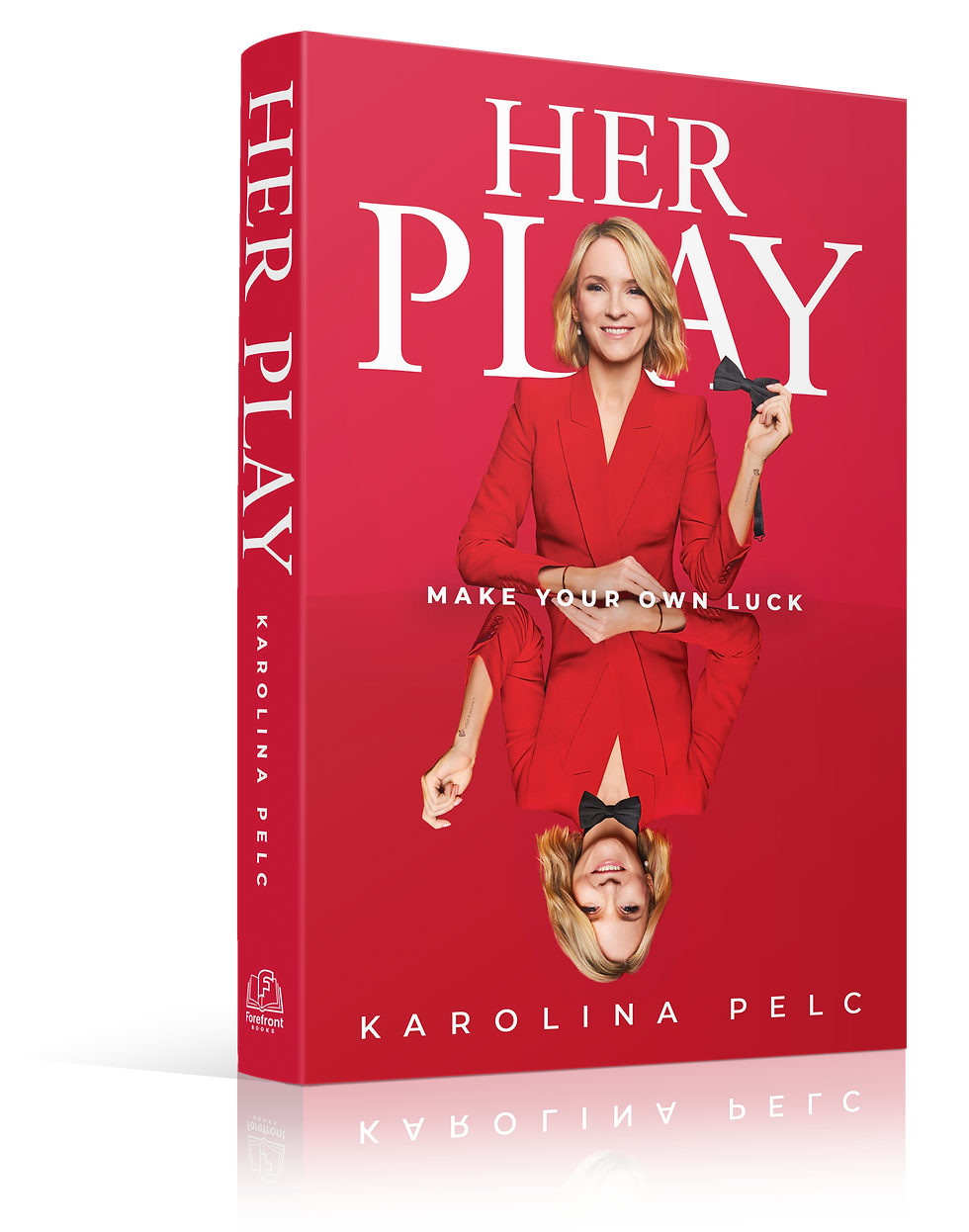
Her Play by Karolina Pelc is available to buy on Amazon now. You can connect with her on LinkedIn here.

Karolina Pelc is a visionary entrepreneur, investor, and B2B gaming software expert renowned for her high-stakes business strategy. Demonstrating masterful execution, she founded and scaled BeyondPlay, securing over €7 million in funding. Within just three years, she orchestrated one of the iGaming industry’s fastest exits by selling the company to the top U.S. gaming brand. Recognised as a LinkedIn Top Startup Development Voice, Pelc has shared her strategic insights at Richard Branson’s Leadership Summit on Necker Island and TechCrunch Startup Battlefield. Her unconventional path underscores a profound expertise in navigating power dynamics and driving high-performance growth.


